
Two weeks ago I promised you the most powerful number most SME owners have never calculated. Here it is: the Cash Conversion Cycle, or CCC. It answers one deceptively simple question—from the day you pay a supplier to the day a customer pays you, how many days does your cash spend trapped inside the business?
That number, more than any other, determines how much working capital you need, how vulnerable you are to shocks, and how much financing you must raise to grow. And you can calculate it this afternoon, from reports you already have.
The three components
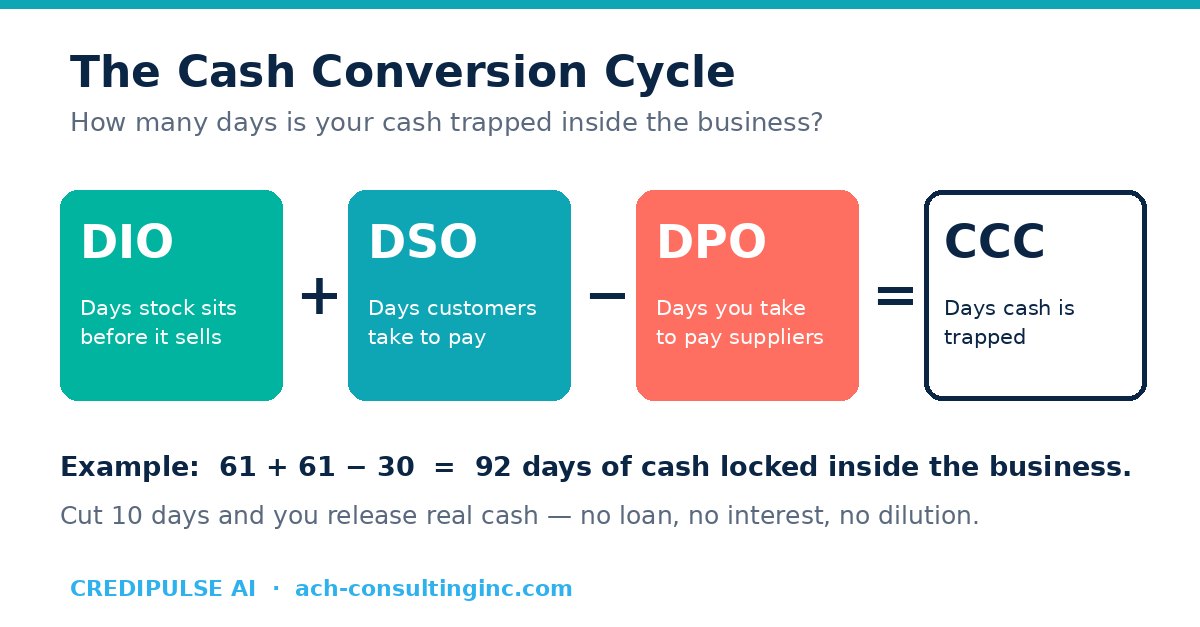
The CCC is built from three measurements, each answering a question in plain English:
- Days Inventory Outstanding (DIO) — How long does stock sit before it sells? Take your average inventory, divide by cost of goods sold, multiply by 365. If you hold US$100,000 of average stock and your annual cost of sales is US$600,000, your DIO is about 61 days.
- Days Sales Outstanding (DSO) — How long do customers take to pay? Average receivables divided by revenue, times 365. If customers owe you US$150,000 on annual sales of US$900,000, your DSO is about 61 days—regardless of what your “30-day terms” claim.
- Days Payables Outstanding (DPO) — How long do you take to pay suppliers? Average payables divided by cost of goods sold, times 365. Payables work in your favour: they are cash you get to hold a little longer.
The formula: CCC = DIO + DSO − DPO.
Using the numbers above with, say, 30 days of payables: 61 + 61 − 30 = 92 days. That business has three full months of operating cash locked inside its own walls at all times.
Why this number changes everything
Once you know your CCC, abstractions become arithmetic. A 92-day cycle on US$900,000 of revenue means roughly a quarter of a year’s operating cash is permanently tied up. Cut that cycle by just ten days and you release tens of thousands in cash—without a single new sale, without a loan, without touching margin.
The CCC also transforms the financing conversation from Week 2. Walk into a lender saying “I need US$100,000” and you are asking for a favour. Walk in saying “My cycle is 92 days, my growth plan adds this much working capital requirement, and here is the forecast showing repayment as the cycle turns”—and you are presenting a credit case. Lenders fund arithmetic far more readily than hope.
What “good” looks like
There is no universal target. A distributor, a manufacturer, and a consultancy live in different worlds, and some supermarkets famously run negative cycles—they sell stock for cash before their suppliers’ invoices fall due, so customers effectively fund the business. Your goal is not someone else’s number. Know your own number, understand why it is what it is, and then push it downward deliberately, quarter after quarter.
Be aware, too, that the CCC is an average that can hide trouble: one giant slow-paying customer, or a warehouse corner of dead stock, can be masked by healthier flows around them. The number is the beginning of insight, not the end.
Your one action this week: pull your latest balance sheet and P&L, and compute DIO, DSO, and DPO. Write your CCC on a sticky note where you can see it. Next week I will show you the practical levers that shrink each component—the same playbook corporate treasurers use, sized for SMEs.
This series leads to the Tuesday 20 October 2026 launch of CrediPulse AI—an app ecosystem that tracks your CCC in real time and turns it into financing-ready insight. The early-access waitlist is now open; join via the link below.
Part of the Money Moves Forward series by ACH Consulting Inc. CrediPulse AI launches Tuesday 20 October 2026 — join the early-access waitlist at ach-consultinginc.com.